Published research article on a theoretical study of the reaction mechanism involving water molecules in the Prilezhaev reaction.
A paper on our joint research project with Yamaguchi University and AIST, titled “Theoretical and Experimental Mechanistic Study of Water Molecule Involvement in the Prilezhaev Reaction,” has been published.
The Prilezhaev reaction is a reaction that produces epoxides using an alkene and a peracid such as m-chloroperbenzoic acid (mCPBA). This reaction proceeds in a single-step concerted mechanism. mCPBA, used in organic synthesis, contains water to suppress explosiveness, but the effect of water on the reaction has not been considered until now.
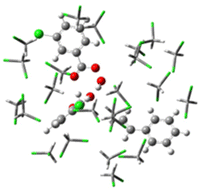
In this study, to investigate the effect of water on the reaction mechanism, we determined the thermodynamic parameters of the Prilezhaev reaction between styrene and mCPBA. The activation free energy, including solvent effects, was calculated using the SMD method and the QM/MC/FEP method. As a result, the thermodynamic parameters of the reaction directly involving two water molecules showed better agreement with experimental data than those based on the concerted mechanism. This result suggests that in solvents containing water, water molecules are involved in the progress of the mCPBA-mediated Prilezhaev reaction.
- Kawahara, E. M.; Ogawa, M.; Yamato, S.; Yamaguchi, T.; Hori, K.; Sumimoto, M. Theoretical and Experimental Mechanistic Study of Water Molecule Involvement in the Prilezhaev Reaction. Phys. Chem. Chem. Phys. 2023, 25 (27), 18102–18108. DOI: 10.1039/D3CP00820G