NMR Spectrum (Nuclear Magnetic Resonance Spectrum)
(Automatically translated from the original Japanese text)
An NMR spectrum is obtained by irradiating a substance under measurement with pulsed radio waves placed under a magnetic field and measuring the wavelength absorbed by the atomic nuclei. The absorption wavelengths of NMR originate from the signals of individual atoms such as H and C atoms in each compound, and the compound structure can be identified by assigning the NMR peaks.
In quantum chemical calculations, the absolute shielding constant can be calculated for an optimized compound structure, and the chemical shift can be obtained by finding the difference from the absolute shielding constant of a reference substance. Furthermore, generally , In this case, the reference substance is tetramethylsilane (TMS) In this case, the reference substance is trichlorofluoromethane ().
1. Comparison of NMR spectrum calculation examples and measurement results
Below is an example of a calculation in which an NMR spectrum was calculated using quantum chemical calculations.
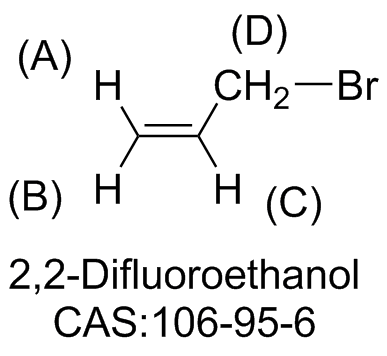
1.1 3-bromo-1-propene (CAS number:106-95-6)
-
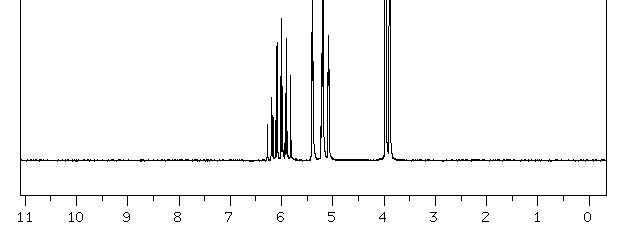
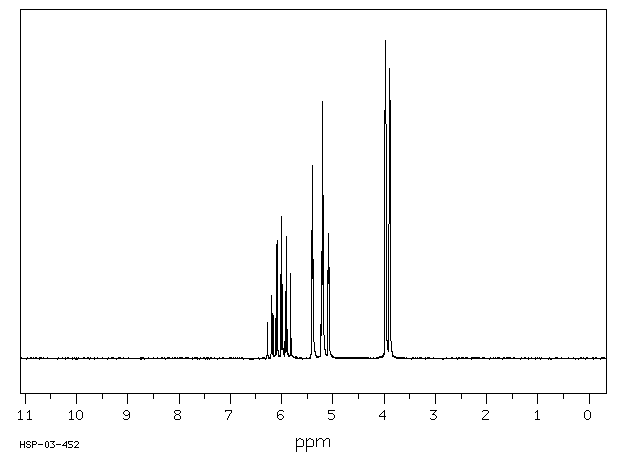
NMR spectrum (measurement) SDBSWeb : http://sdbs.db.aist.go.jp (National Institute of Advanced Industrial Science and Technology, 06/2020)
-
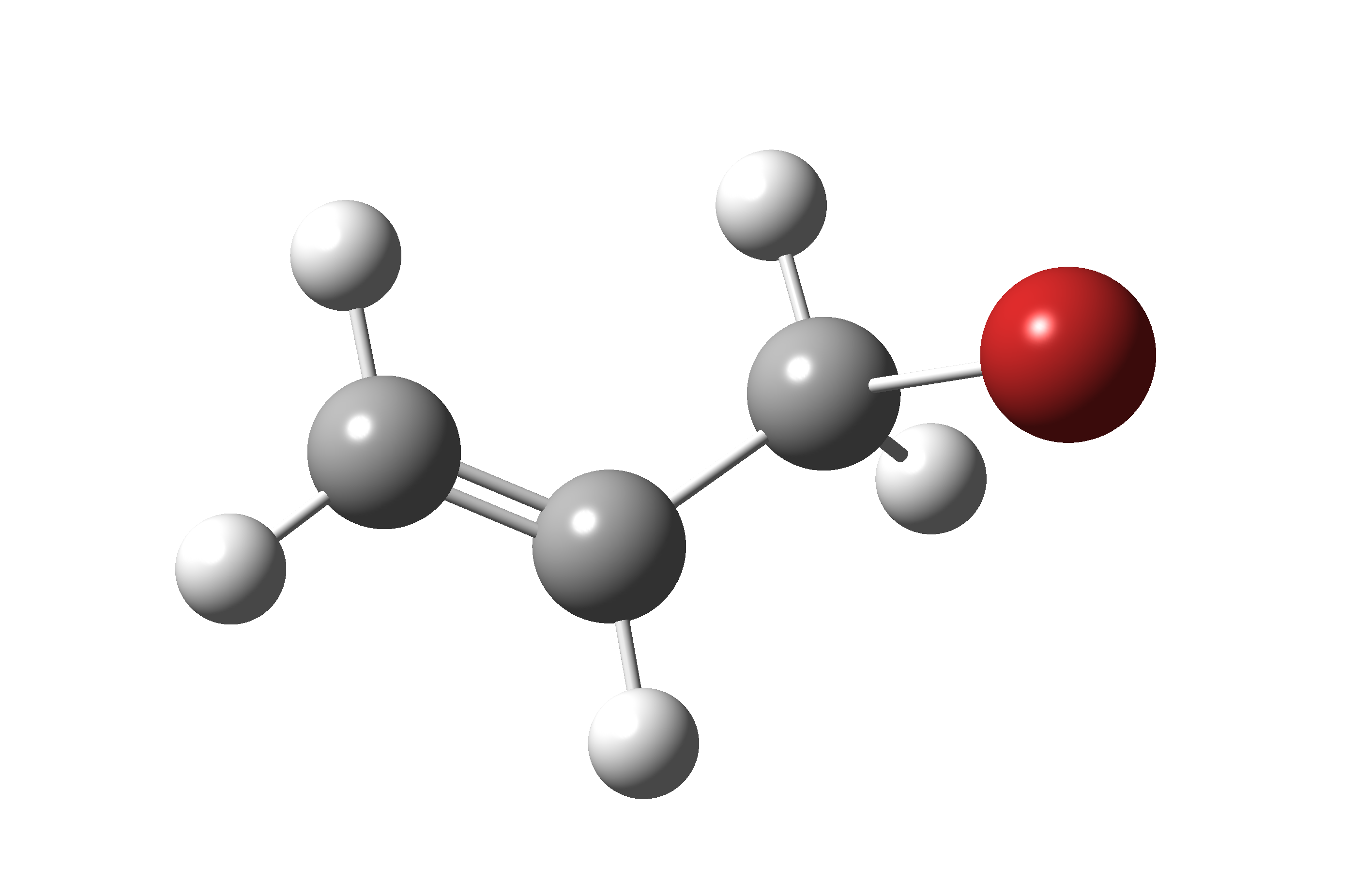
Optimized structure (B3LYP/6-31G(d))
-
NMR spectrum (theoretical calculation) Calculation level::mPW1PW91/6-311+G(2d,p)、Solvent effect::scrf method ()
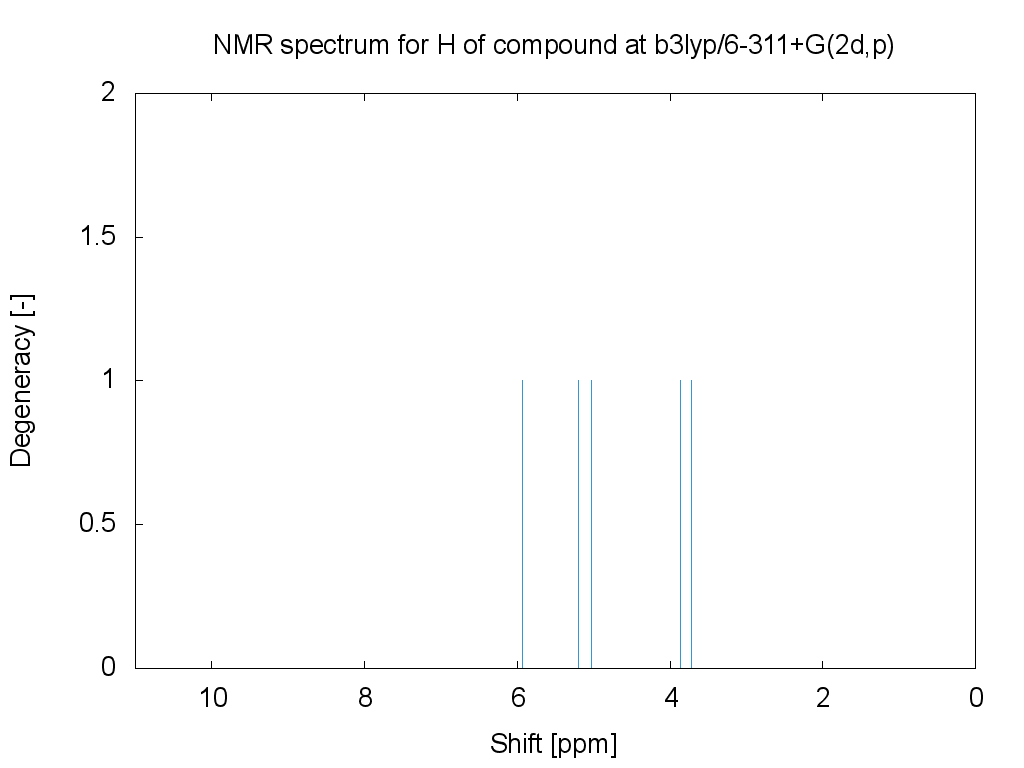
| Assign | Shift(eq) | Shift(cal) |
|---|---|---|
| A | 5.300 ppm | 5.253 ppm |
| B | 5.150 ppm | 5.099 ppm |
| C | 6.015 ppm | 5.982 ppm |
| D | 3.934 ppm | 3.716 ppm |
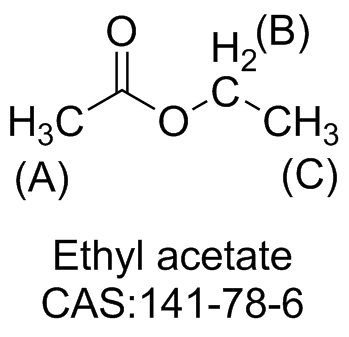
1.2 Ethyl acetate (CAS number:141-78-6)
-
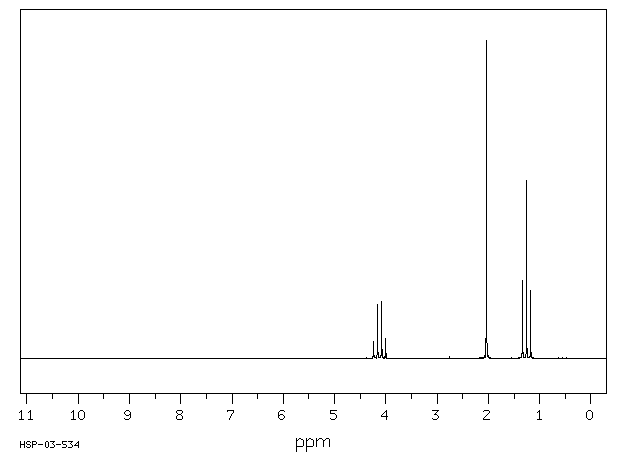
NMR spectrum (measurement) SDBSWeb : http://sdbs.db.aist.go.jp (National Institute of Advanced Industrial Science and Technology, 06/2020)
-
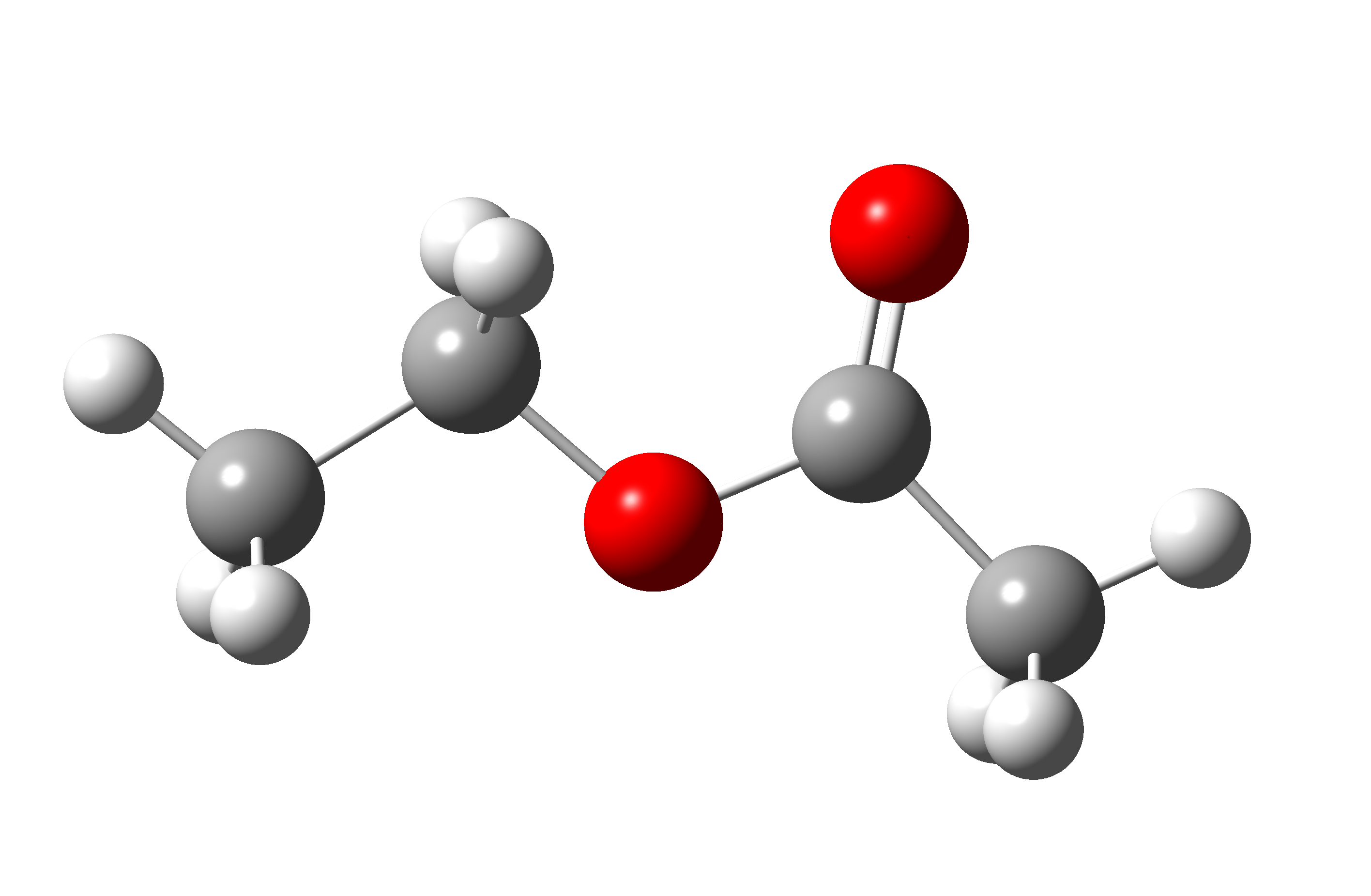
Optimized structure (B3LYP/6-31G(d))
-
NMR spectrum (theoretical calculation) Calculation level:mPW1PW91/6-311+G(2d,p)、Solvent effect: scrf method ()
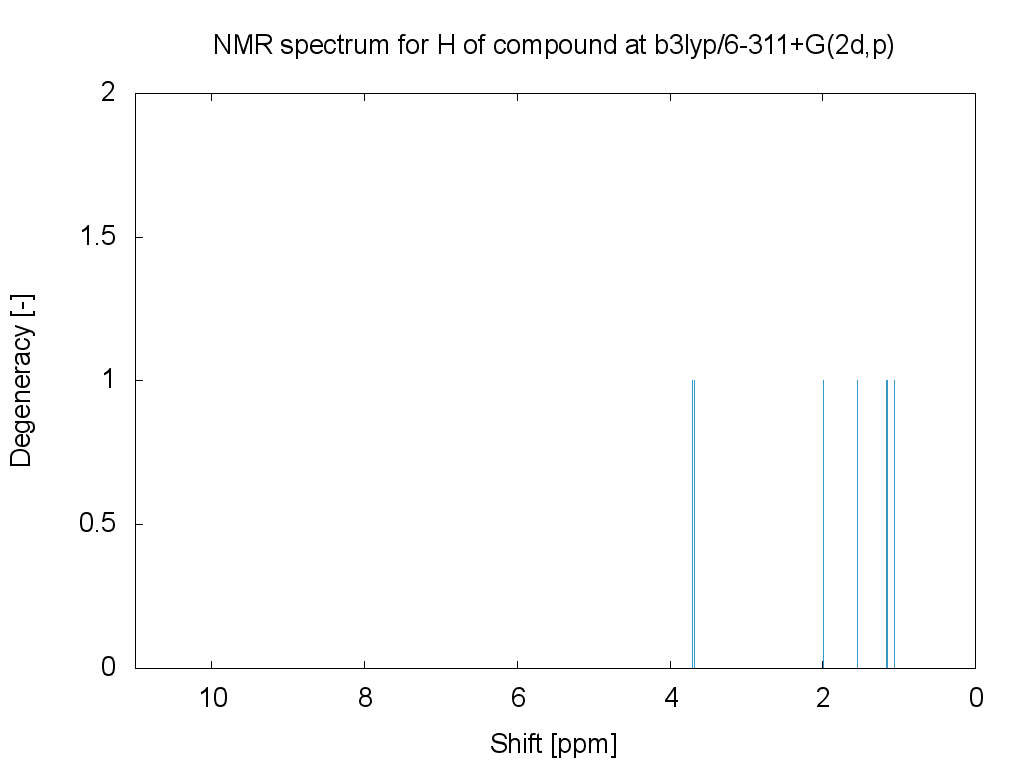
| Assign | Shift(eq) | Shift(cal) |
|---|---|---|
| A | 2.038 ppm | 1.847 ppm |
| B | 4.119 ppm | 3.688 ppm |
| C | 1.260 ppm | 1.126 ppm |
2. Scaling Factor
NMR spectra obtained through quantum chemical calculations can be made closer to experimental values by multiplying the wavenumber (energy) by a scaling factor to correct for errors at the theoretical calculation level. Representative scaling factors include the following:
| Calculation level | Scaling factor | ||||
|---|---|---|---|---|---|
| 1H | 13C | ||||
| Structural optimization calculation | NMR calculation | slope | intercept | slope | intercept |
| B3LYP/6-31+G(d,p) | mPW1PW91/6-311+G(2d,p) | -1.0936 | 31.8018 | -1.0533 | 186.5242 |
| B3LYP/6-311+G(2d,p) | mPW1PW91/6-311+G(2d,p) | -1.0933 | 31.9088 | -1.0449 | 187.1018 |
| B3LYP/6-31+G(d,p) | PBE0/6-311+G(2d,p) | -1.0958 | 31.7532 | -1.0533 | 187.3123 |
| B3LYP/6-311+G(2d,p) | PBE0/6-311+G(2d,p) | -1.0956 | 31.8603 | -1.0450 | 187.8859 |
| M062X/6-31+G(d,p) | mPW1PW91/6-311+G(2d,p) | -1.0938 | 31.8723 | -1.0446 | 186.7246 |
For more detailed numerical values for each level, please refer to the paper orCHESHIRE CCAT